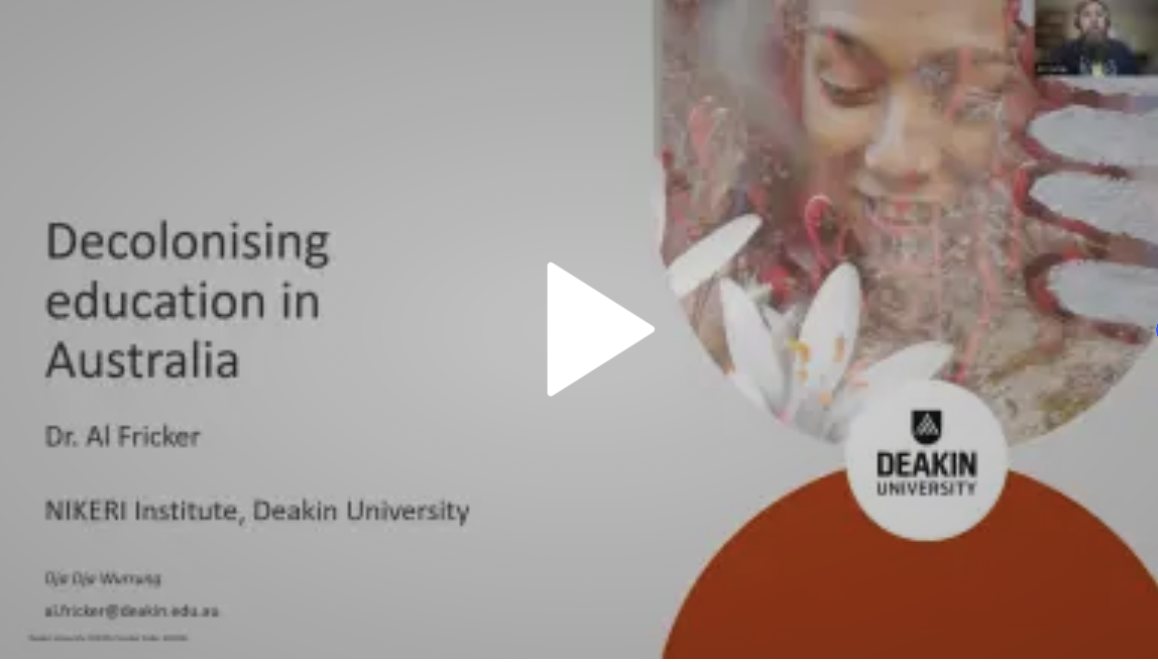
Al Fricker discusses the concept of decolonising as it relates to education. He discusses decolonisation more broadly by drawing on writers like Franz Fanon1. He also considers how issues of decolonising play out in wider society as well as in education. He guides us to think about Australian Indigenous2 people as among the oldest teachers in the world, due to their enduring histories, who prioritise wellbeing, relationships and whole learner growth in the educative processes. Also, knowledge is considered as sacred and divine.
How do these insights allow us to re/think education?
Footnote 1: Correction: Al accidentally refers to Franz Fanon as being Algerian, however, he was born in Martinique and then spent much time in his adult life in Algeria, joining the colonial resistance there.
Footnote 2: On Al’s slides he uses a capital I for Indigenous when it is a proper noun and a lower case i for indigenous when it is referring to global indigenous contexts.
Additional Resources
📖 Book Chapter: Fricker, A. (2024). Planetary Justice and Decolonizing Pedagogy: Teaching and Learning in Solidarity with Country. In A. Fricker, M. Lobo & E. Mayes (Eds.). Planetary Justice Stories and Studies of Action, Resistance and Solidarity (pp. 163-177). Policy Press
🌐 Website: Why are First Nations perspectives sidelined in our science curriculum?

 Race, Empire and Education Collective