June 2026
For our next online reading group session (June 2026), we will be in conversation with authors who are grappling with challenging issues: the societal impact of DNA research, e.g. in education, and the unequal global response to violence against Muslim populations. These conversations are united by their concern with processes of racialisation and racism, often the unnamed factors in such debates.
See below for more details about the sessions.
Registration details circulated via the mailing list. See how to subscribe at the bottom of the page.
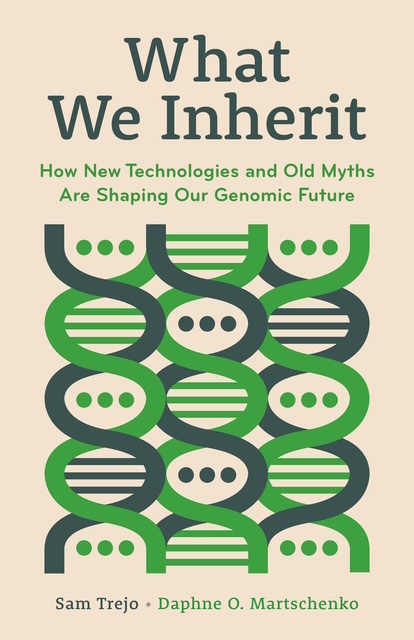
What We Inherit: A Book Launch Discussion with Daphne Martschenko & Sam Trejo
Wednesday 17th June, 17.00-18.00 (UK/BST)
Join us for a discussion of the publication, What We Inherit, facilitated by Rosa Gillespie Cheesman (Department of Psychology, University of Oslo). Rosa will lead a conversation with the authors Daphne Martschenko and Sam Trejo, followed by a Q&A session.

About What We Inherit:
Over the past decade, the field of human genetics has produced an extraordinary range of discoveries—including the ability to use a person’s DNA to estimate their likelihood of developing a trait or disease. But are these new technologies ready to leave the research lab and be deployed in schools, fertility clinics, and the wider world? In their new book What We Inherit, Daphne Martschenko (Assistant Professor – Stanford Center for Biomedical Ethics) and Sam Trejo (Assistant Professor – Princeton Department of Sociology) offer different perspectives on the societal impact of the rapidly unfolding DNA revolution. Trejo, a sociologist and expert on the complex ways people’s genes influence their life’s trajectory, believes that new genomic tools—if used thoughtfully—can improve society; Martschenko, a bioethicist who specializes in the thorny social issues raised by biomedical advances, is more cautious. They debate both the risks and the opportunities posed by such new technologies as at-home genetic tests and polygenic embryo selection—all while engaging in a wide-ranging dialogue on ideology, biology, and social inequality.
Rethinking Critical Race Theory: A Book Conversation with Tyler Denmead and Amina Shareef
Thursday 25th June, 16.00-17.00 (UK/BST)
Join us for a discussion of Rethinking Critical Race Theory. The conversation with Tyler Denmead (Associate Professor – University of Cambridge) and Amina Shareef (Independent Researcher), and facilitated by Simina Dragoș (Research Fellow, Queens’ College Cambridge) addresses the uneven global response to violence against Muslim populations, building on a question posed by Salman Sayyid: why has Palestine mobilised widespread student protest, while contexts such as India, Kashmir, China, and Myanmar have not?

Tyler and Amina argue that dominant understandings of race obscure the global nature of anti-Muslim racism. Drawing on W. E. B. Du Bois’ concept of the “colour line,” Palestine is often interpreted through a visible racial binary, rendering injustice more legible. By contrast, violence against Muslims elsewhere is less recognised as racial because it does not conform to a narrow, skin colour–based understanding of race.
They challenge two key limitations: reducing race to phenotype and confining racial analysis within nation-states. In response, we propose a global critical race framework that understands race as dynamic, transnational, and often articulated through religion, culture, and security discourse.
Central is “Muslimness” as a racialised category—historically rooted, elastic, and used to justify exclusion and violence. They show how education policies shaped by the Global War on Terror, including the UK’s Prevent strategy, institutionalise this logic.
They call for a global framework to support transnational solidarities.
#Challenging image on Homepage by Focal Foto on Flickr